Certifications & Quality Standards
Certification documentation for procurement, professional approval and institutional integration. All certificates independently issued — not self-declared.
Hydrogen Wellness™ products are manufactured within established quality management environments and supported by internationally recognised manufacturing, engineering and product-quality standards.
Our commitment is to quality, consistency, traceability and customer confidence.
ISO 9001 Quality Management System
Selected Hydrogen Wellness™ products are manufactured within facilities operating quality management systems certified to ISO 9001.
ISO 9001 is an internationally recognised quality management standard.
This certification relates to manufacturing quality systems and processes.
Important disclaimer
ISO 9001 certification relates to quality management only. Hydrogen Wellness™ products are general wellness devices.
Premium PEM Technology
Hydrogen Wellness™ systems utilise Proton Exchange Membrane (PEM) electrolysis technology designed for purity, consistency and operational reliability.
Where applicable, premium membrane configurations and long-life component architectures are available depending on product model and configuration.
Quality-Controlled Manufacturing
Products are assembled within documented quality-control processes and undergo inspection prior to shipment.
Our focus is consistency, reliability and long-term operational performance.
Global Market Experience
Products manufactured by our supply partners are distributed into multiple international markets.
Hydrogen Wellness™ supports customers globally through direct distribution and regional delivery networks.
FCC Part 15 Subpart B — Electromagnetic Compliance
Documentation
- Test report number:
- LST250598095FR
- Certificate number:
- LST250598095F
- Testing laboratory:
- Shenzhen LST Technology Co., Ltd.
- Accredited independent test lab · Bao'an District, Shenzhen, China
Test parameters & results
- Test standards:
- FCC Part 15 Subpart B · ANSI C63.4:2014
- Test date:
- May 22–30, 2025
- Test voltage:
- AC 120V (US voltage specification)
- Conducted emission test:
- PASS
- Radiated emission test:
- PASS
- Overall result:
- PASS
Models covered
QY-A900 · QY-A1200 · QY-A1800 · QY-A3000 · QY-F6000 · QY-F8400 · WZ-1
What FCC Part 15 Subpart B means
FCC Part 15 Subpart B covers electromagnetic emission limits for unintentional radiators — electronic devices that do not intentionally transmit radio frequency signals. This is the correct FCC compliance pathway for hydrogen generation equipment. Testing was conducted at US 120V specification in a fully equipped anechoic chamber using calibrated Rohde & Schwarz and Agilent test instruments. Both conducted and radiated emission tests passed all FCC Part 15 Class B limits.
Anechoic chamber test photographs
The following photographs are taken from the official FCC test report (LST250598095FR) and show the machine being tested under radiated emission conditions in a fully equipped RF-shielded anechoic chamber.
FCC certification — why it matters for European and German buyers.
Understanding Our Quality Commitments
These certifications and quality standards relate to:
- Manufacturing quality systems
- Production processes
- Quality control
- Product consistency
- Traceability
- Supplier quality management
They do not constitute:
- Medical device approval
- Therapeutic approval
- FDA clearance
- TGA approval
- Disease-treatment claims
- unless expressly stated for a specific product and jurisdiction
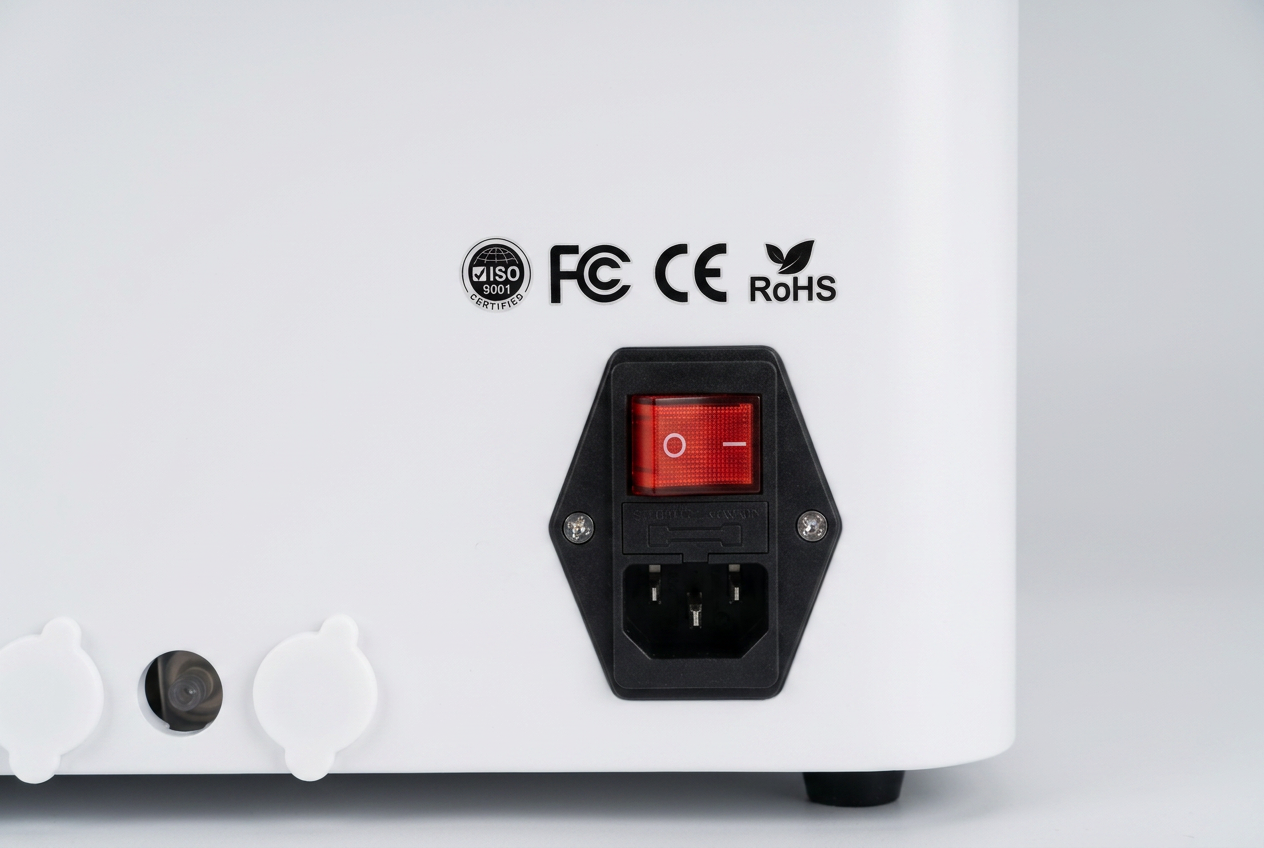
Certification marks

Conformité Européenne mark indicating the product meets EU health, safety and environmental protection requirements for sale within the European Economic Area.

Federal Communications Commission certification confirming the device complies with US electromagnetic interference standards for unintentional radiators.

Restriction of Hazardous Substances directive limiting the use of specific hazardous materials in electrical and electronic equipment.

International standard for quality management systems, ensuring consistent product quality and continuous improvement in manufacturing processes.
Marks as applied to product
Documentation available on request.
Full certification documentation — including certificates, issuing bodies, applicable standards, and validity dates — is available to professional operators, institutional procurement teams, and verified professional buyers.
Documentation is provided under standard commercial confidentiality terms within 2 business days of request.
Quality you can verify.Confidence in every detail.
Related Content
Keep exploring
Hand-picked guides, research, comparisons and products related to this page.
Understanding Certifications
What ISO 9001, CE, RoHS and FCC mean for a hydrogen wellness machine.
How Hydrogen Machines Generate Hydrogen
A clear explanation of how a premium hydrogen wellness machine produces hydrogen.
Total output vs pure hydrogen output
Why an inhalation machine quotes two figures — total gas (H₂ + O₂) and pure hydrogen — with the H6 Pro™ and H8 Pro™ numbers side by side.
Machine Features Explained
A glossary of the most important features on a premium hydrogen wellness machine.
Hydrogen Inhalation Machine Buyer's Guide
Output, build, certification and ownership — choosing a premium inhalation machine.
Hydrogen Bath Machine Buyer's Guide
What to look for in a premium hydrogen bath system for the home.
H6 Pro™ Multi-User H2 Inhaler
6,000 ml/min separated H₂ + O₂ inhalation. Up to three cannulas.
H8 Pro™ Multi-User H2 Inhaler
8,400 ml/min performance hydrogen inhalation for shared use.
Find Your Wellness System
Five short questions — one tailored recommendation across inhalation, bathing and water.
What is a hydrogen inhalation machine?
A hydrogen inhalation machine is a wellness appliance that produces molecular hydrogen gas (H₂) for inhalation through a nasal cannula. The Hydrogen Wellness™ H…
What is the QY-F series — and how does it differ from standard hydrogen inhalers?
A hydrogen inhalation machine uses PEM/SPE (Proton Exchange Membrane / Solid Polymer Electrolyte) electrolysis to split purified water into its component gases …