
Home Spa · The Idea
The Home Spa
A home spa is less a room than an idea — one that has quietly returned to the modern home, unbothered by trend and unhurried by fashion. It is the place where the day is set down.
Beginning
The room where the day is set down
Most homes have a place where the day slows before it ends. In older houses it was a reading chair. In smaller apartments it might still be a kitchen table. In modern homes, increasingly, it is the bathroom — not the utilitarian one from a decade ago, but a considered room, closer to a small private spa than a functional wet space.
The home spa is that room. It is not defined by square meters or by fittings. It is defined by pace. The tap runs a little longer. The lights are lower. The phone stays outside. The bath is not an errand but an event, and the room itself has been given the same attention as a favourite corner of the house.
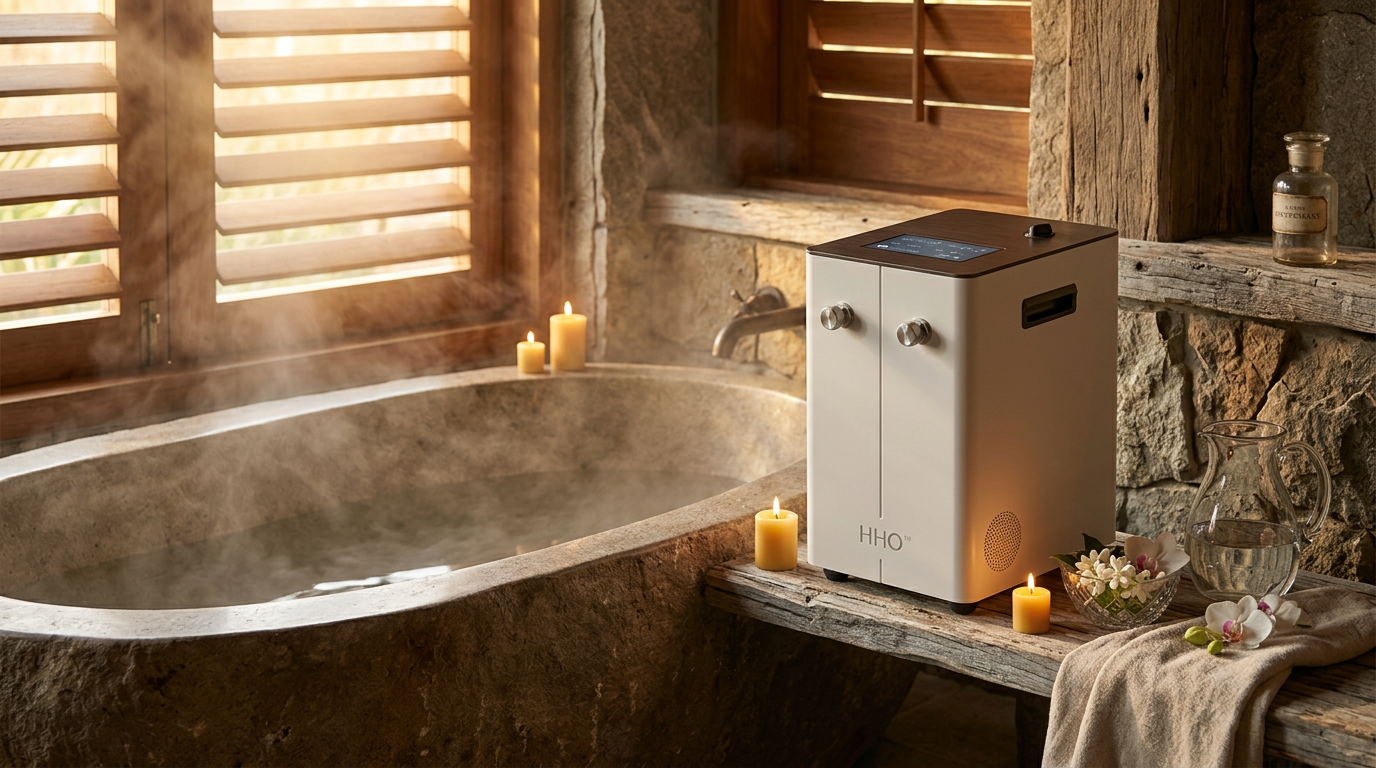
Hydrogen bathing arrives inside this idea. It doesn't replace the ritual; it deepens it. The bathwater is quietly enriched with molecular hydrogen — visible to no one, felt only in the softer hour that follows — and the room, unchanged in every visible way, becomes the calmest twenty minutes of the day.
Materials
The surfaces that stay quiet
A home spa is often described by what it is not. It is not shiny. It is not busy. It doesn't announce itself with feature walls or novelty fittings. The materials that carry the idea best — honed stone, unfilled travertine, oak, brushed brass, thick linen — share one quiet quality: they age well and they don't compete for attention.
The palette is short. Two or three warm tones and a single darker anchor. Grout lines that disappear. Fittings that read as jewellery — sparingly used, well made, and small enough to leave the wall alone. The room's job is to hold the ritual, not to perform.
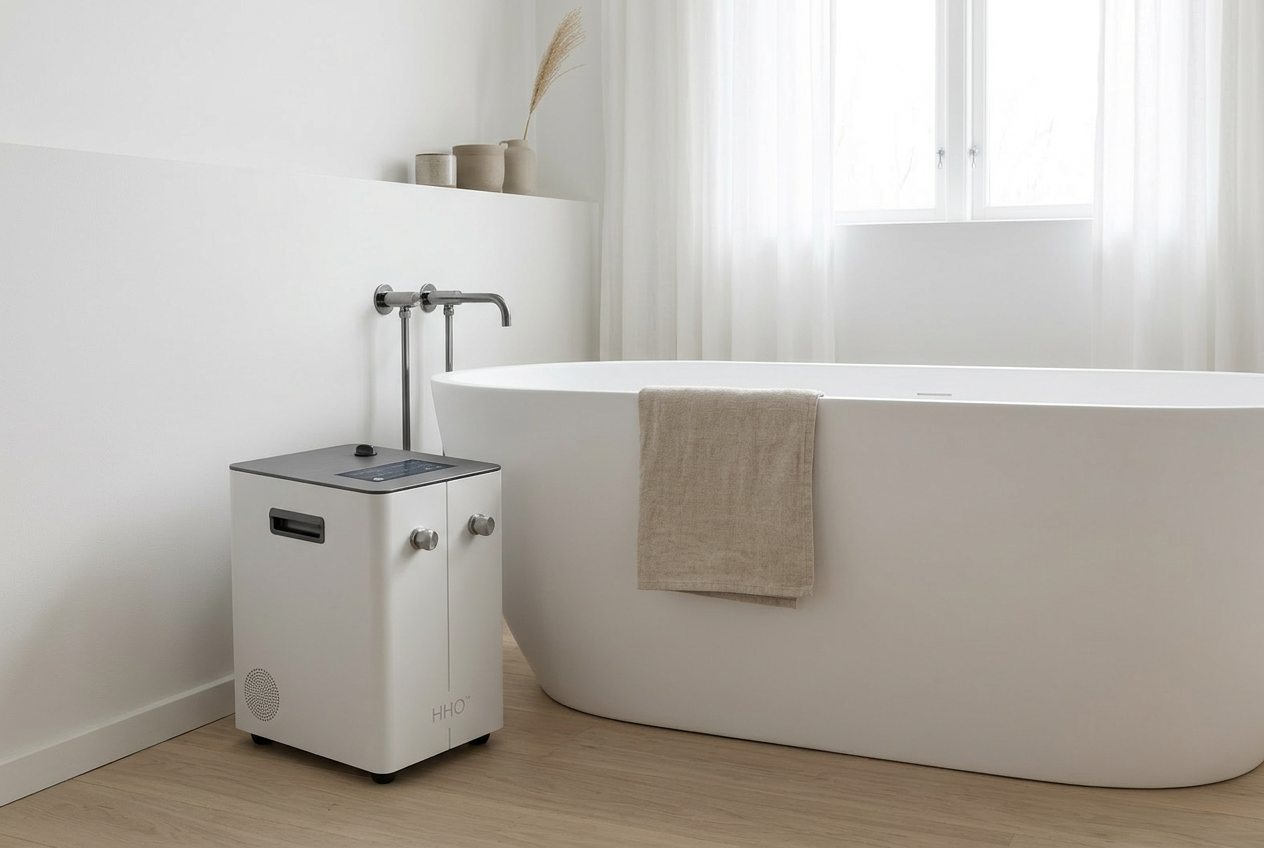
A hydrogen bath system fits this brief unusually well. It is a small, quiet appliance that sits at the side of the tub, does its work invisibly, and adds no visual noise to the room you have carefully composed.
“The home spa is defined by pace, not by square meters.”
Light
Warmer than you think, dimmer than you'd guess
Light is the single most under-considered element in the modern bathroom. Cold ceiling downlights have quietly ruined more spa moments than any other design decision. The remedy is not more fittings but fewer, warmer, and lower.
The colour temperature to aim for is between 2400K and 2700K — the light of a candle-lit dining room, not an operating theatre. A single dimmable wall wash, a low pendant near the bath, and, if the room allows, one candle within reach of the tub, is enough for the entire ritual.
The result is a room that, without any renovation, feels twenty degrees warmer than the fluorescent bathroom next door.
Engineering & specification
The engineering brief lives on HydrogenMachines.com.au
Cell architecture, hydrogen output, certifications, warranty and commercial specifications are documented in full on our sister site — written for architects, spas and buyers who want the technical depth.
Visit HydrogenMachines.com.au →Questions
Considered answers
- Do I need a large bathroom to build a home spa?
- No. Some of the most successful home spas are small — a single tub, warm light, quiet materials. The idea travels well into a compact bathroom because it is defined by pace, not scale.
- Where does hydrogen bathing fit into a home spa?
- Naturally. A hydrogen bath system sits at the side of the tub and enriches ordinary bathwater with molecular hydrogen. Nothing visible changes; the ritual simply gains a quieter, softer character in the hour that follows.
- How much does it cost to build a home spa?
- The idea is closer to editing than building. Warmer lighting, better textiles, a small ritual object at the side of the tub and, if the moment is right, a hydrogen bath system — most owners begin with what they have.
- Is a home spa only for evenings?
- Most owners find the evening bath becomes the anchor, but a slower Sunday morning bath is a natural second use. The point is the room, not the clock.
The Pillar
Return to Hydrogen Bathing
Related Content
More from the Home Spa collection
Rooms, materials and rituals — quietly composed.
Hydrogen Bathing Explained
What a hydrogen bath is, how the machine works, and what to expect from your first session.
Creating a Home Spa Experience
How to design a beautiful, immersive home spa around a hydrogen bath system.
Choosing a Hydrogen Bath Machine
A buyer's framework for selecting a premium hydrogen bath system.
Bath Preparation Guide
How to prepare a hydrogen bath session for the best experience.
Hydrogen Bath Machine Buyer's Guide
What to look for in a premium hydrogen bath system for the home.
Hydrogen Bath Water Machine Buyer's Guide
Choosing a hydrogen bath water system — fine-bubble output, build and ownership.
Bath One™ Hydrogen Bath Machine
Premium hydrogen-rich bathing system for the home spa.
H6 Pro™ Multi-User H2 Inhaler
6,000 ml/min separated H₂ + O₂ inhalation. Up to three cannulas.
Find Your Wellness System
Five short questions — one tailored recommendation across inhalation, bathing and water.
What is hydrogen bathing — and how does it compare?
Hydrogen bathing dissolves H₂ into bath water, where it can be absorbed transdermally and inhaled in low concentrations from the steam above the bath. The dose …
What is a molecular hydrogen machine?
"Molecular hydrogen machine" is the generic engineering term for any device that produces molecular hydrogen (H₂) — the smallest stable molecule in nature. It c…